
A 30-day action plan should make your next step easier to see. It does not need to account for every possibility or fill every open hour. Its purpose is to connect something that matters to you with actions you can take in the life you actually have.
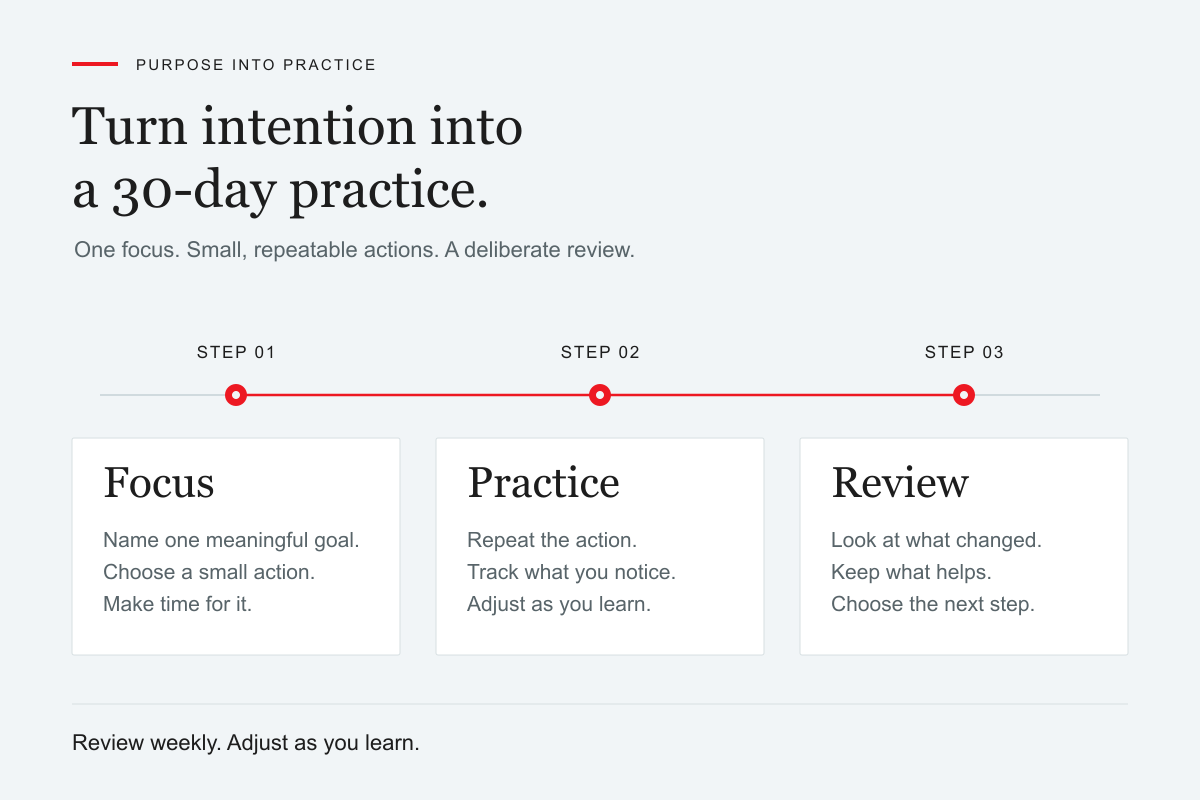
The most useful plan has room for work, responsibilities, uneven energy and the occasional missed day. Try a simple rhythm: Focus on one outcome, Practice the actions that support it, and Review what you learn.
Focus: choose one meaningful outcome
Start with a result you want to work toward over the next 30 days. Make it specific enough that you can recognize progress. “Get my career together” is difficult to act on. “Complete a first draft of my professional portfolio” gives you something concrete to organize around.
Write your outcome in one sentence. Then explain why it matters now. That explanation can help you make decisions when other demands compete for your attention.
Choose an outcome you can substantially influence. You can prepare an application, request a conversation or finish a draft. You cannot control whether someone hires you, replies promptly or approves your idea. Keep those distinctions visible.
Practice: turn the outcome into scheduled actions
Work backward from your outcome and identify the few actions that would move it forward. Use verbs that describe visible work: outline, draft, call, compare, rehearse or revise. “Work on the project” leaves too many decisions for later.
Put those actions into your actual weekly calendar. Look at existing commitments before selecting a time. Two workable sessions may serve you better than an ambitious daily schedule that requires you to rearrange everything.
For each session, write three things: when it will happen, what you will do and what a reasonable stopping point looks like. For example: “Tuesday, 6:30–7:00 p.m.: outline the first project summary; stop when the main sections are listed.”
A hypothetical four-week plan
Imagine a professional whose outcome is to finish a first draft of a portfolio. They choose two 30-minute work sessions each week, with a short review on Sunday. Their plan could look like this:
- Week 1: define the scope. Choose three projects to feature and outline the sections each summary needs.
- Week 2: develop the content. Draft the first two project summaries, focusing on the problem, contribution and relevant work.
- Week 3: assemble the draft. Write the third summary and place the content into a simple, consistent format.
- Week 4: review and refine. Check clarity, correct gaps and prepare a version that can be shared when appropriate.
This is a starting estimate, not a promise about how long the work will take. If drafting requires more time, the person can simplify the first version or revise the schedule. The plan should reveal those choices rather than hide them.
Decide how you will recover from a missed day
Before you begin, choose a recovery rule. For example: “If I miss a session, I will take the next scheduled slot and begin with the smallest useful action.” You might also identify one backup window during the week.
A missed session does not require you to double the next one or rebuild the whole plan. Look at what happened. Was the time unrealistic? Was the task unclear? Did another responsibility need attention? Adjust the part that created the problem.
Review: learn before adding more effort
Set aside a few minutes each week to compare the plan with what actually happened. Keep the review practical:
- What did I complete, and what did I learn?
- Which action moved the outcome forward?
- What got in the way: time, information, scope or something else?
- What will I keep, change or remove next week?
At day 30, review the outcome as well as the process. You may have a finished result, a useful first version or better information about what the next stage requires. Decide deliberately whether to continue, change direction or stop.
Before you close this page, write your one outcome and schedule your first action. That is enough to begin. If you would like support turning a meaningful goal into a workable plan, explore Purposeful Action coaching or request a free 30-minute Clarity Call.