
You do not need a polished goal or a complete life plan before speaking with a coach. You might arrive with a decision you keep postponing, a transition that feels difficult to explain, or a sense that your attention is scattered across too many priorities. A useful starting point is being willing to describe what is happening and what you would like to understand better.
Your first life coaching session is also an opportunity to assess the working relationship. You are learning how the coach listens, how the conversation is structured, and whether the approach feels useful for the work you want to do. Here is a practical way to prepare and participate.
Know which kind of conversation you are booking
An introductory conversation and an ongoing coaching session can have different purposes. An introduction gives you space to explain your interest, ask questions, and discuss whether coaching is a suitable next step. A coaching session creates more room to explore an agreed focus and consider what you might do afterward.
At Link Motivation, the free 30-minute Clarity Call is a starting conversation. Requests require approval before confirmation. Before committing to further sessions, ask about the format, session length, fees, scheduling, cancellation arrangements, and expectations between meetings. Clear practical details help you decide whether the arrangement fits your circumstances.
Prepare a starting point, rather than a perfect explanation
Set aside ten minutes to make a few notes. Keep them brief enough to bring into a conversation without feeling that you have to deliver a presentation.
- The situation: What is happening now?
- The significance: Why does it matter to you?
- The desired difference: What would you like to be clearer or more workable?
- Your attempts: What have you already tried, and what did you notice?
- Your question: What would make this conversation worth your time?
For example, a broad wish to feel more focused could become a question about choosing between two commitments. This is an illustration of narrowing a topic, not a requirement to arrive with a finished answer. If you are unsure where to begin, say so.
Agree on what would be useful today
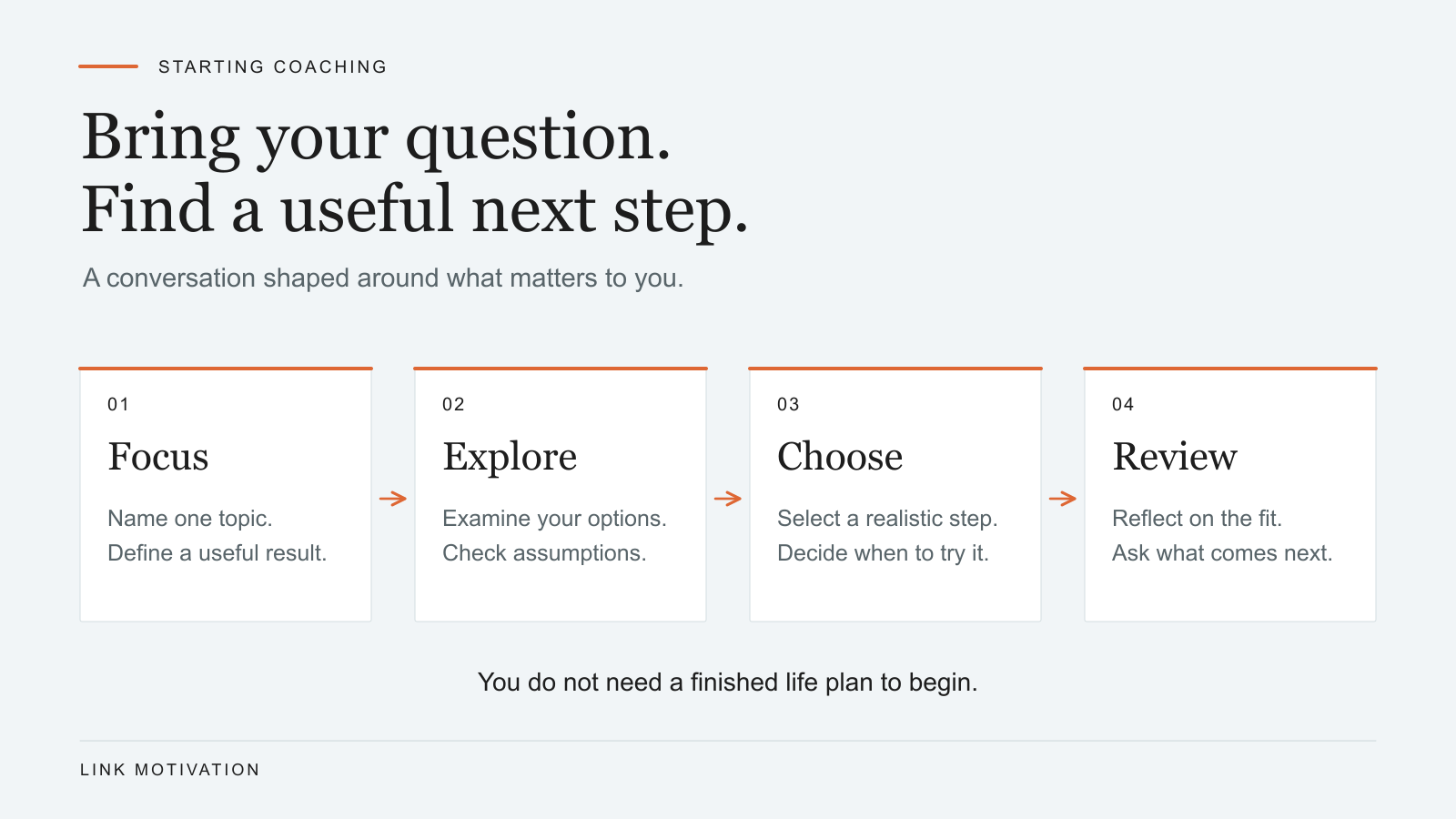
A first conversation can open several possible topics. Choose one that deserves attention now. You can acknowledge the others and return to them later, rather than expecting a single session to settle everything.
Describe a useful outcome in terms you can recognize. Perhaps you want to identify the questions you need to answer before making a decision. Perhaps you want to prepare for a conversation or see which part of a plan is within your control. A clear session focus gives both people a way to notice when the discussion is helping and when it has drifted.
Expect questions, reflection, and room to think
Coaching can involve explaining your situation, pausing to consider a question, and hearing your own thinking reflected back. You might be asked what matters most, what you are assuming, or what another option would require. You remain responsible for your choices.
Help the coach understand your context. Correct an interpretation that misses something important. Ask for a question to be phrased differently when needed. You can also say that you need a moment to think. A productive conversation allows you to participate actively rather than trying to provide the answer you imagine the coach wants.
Separate what you know from what you still need to learn
Try sorting your notes into three short columns: facts, interpretations, and unanswered questions. A fact might be a deadline or a commitment you have already made. An interpretation might be your prediction about how someone will respond. An unanswered question identifies information you can seek.
This exercise can make the next step more specific. Instead of deciding an entire future in one sitting, you may choose to clarify a requirement, speak with someone, or test a small change. For more reflection during a transition, explore finding clarity during a career or life transition.
Choose an action you can realistically carry out
Before finishing, consider what you want to take from the discussion into your week. A useful action has a clear beginning and is small enough to fit the time and resources available. It might involve gathering information, preparing a question, or making room for an important task.
Name when you will do it and what you want to learn. Also consider what might interfere. If the action is too large, reduce its scope before treating it as a commitment. You can use the 30-day action planning guide to develop a longer rhythm once you have a focus.
Reflect on the fit before deciding what comes next
Afterward, ask yourself whether you had room to explain what mattered, whether the questions helped you think, and whether expectations were clear. Notice any questions you still have about the relationship.
Ask how notes and personal information are handled, who can access them, and whether sessions are recorded. Do not assume these arrangements are identical across coaches. You can also discuss how progress would be reviewed and what would happen if your goals or availability changed.
Start with the question that matters to you
Clarity & Direction coaching offers a place to examine priorities and practical next steps. If you would like to discuss your situation with Dr. Kimble, request a free 30-minute Clarity Call. Your request must be approved before the appointment is confirmed.
Keep exploring
Continue with Why Life Coach Certification Matters—and What to Ask, or browse all Link Motivation insights.