
When you are considering work after military service, describing your experience can be a project of its own. You know what a role required, but a prospective employer may not understand its title, terminology, or operating context. At the same time, you may be deciding which parts of that experience you want to carry into your next chapter.
Start with two separate questions: “What can I demonstrate?” and “What do I want to do next?” Your next step should take both seriously. This practical exercise focuses on translating experience, testing possible roles, and gathering information before committing to a direction.
1. Choose an experience before choosing a label
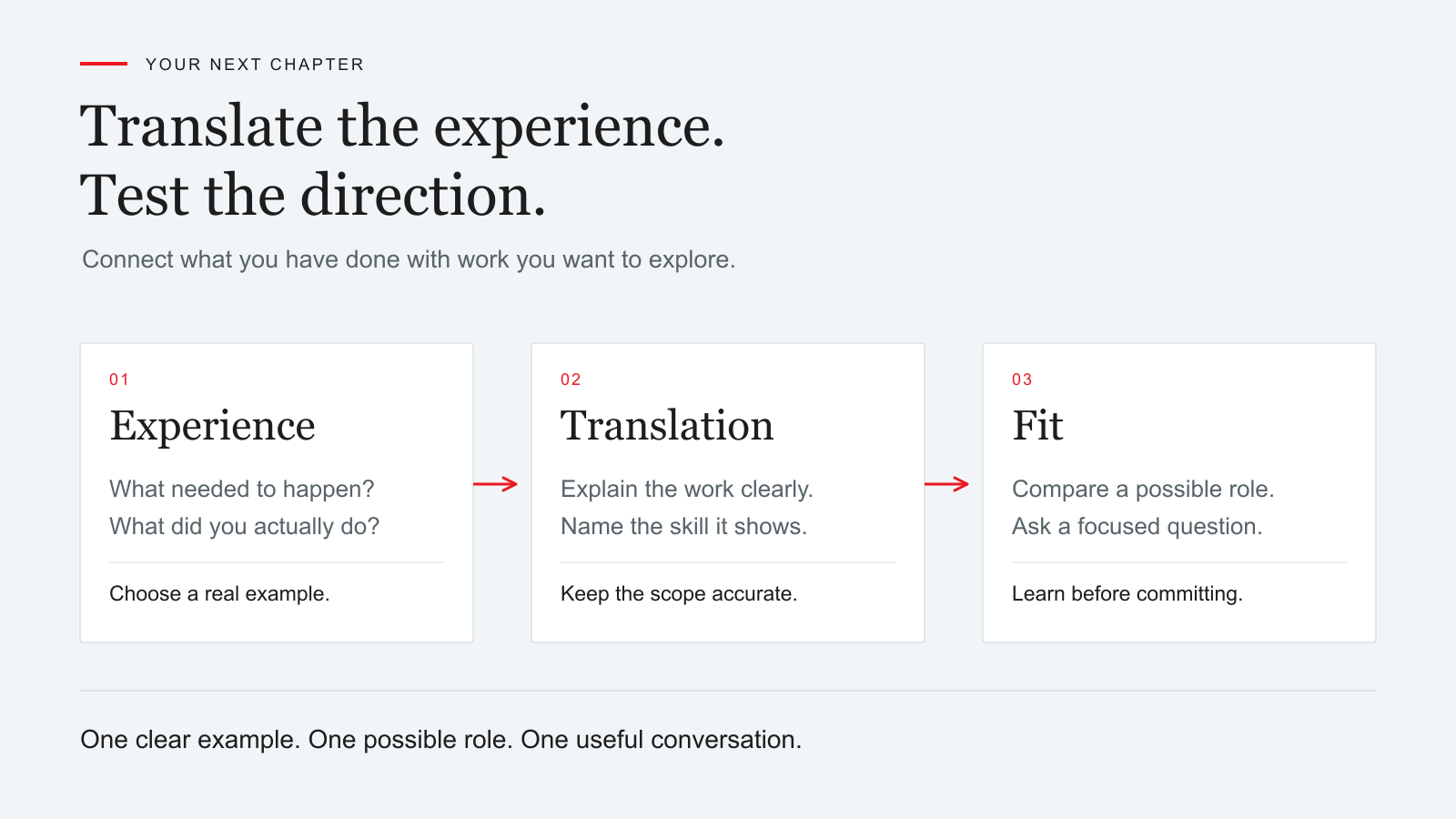
Begin with three situations in which you made a useful contribution. You might have organized a handoff, trained someone, maintained a process, coordinated resources, or helped a group respond to changing priorities. Choose examples that reflect your actual work rather than a list of qualities you think every employer wants.
For each situation, write what needed to happen, what you personally did, who else was involved, and what changed. Use numbers only when you can support them and appropriately share them. A clear description without a number is better than an impressive measure you cannot verify.
Keep the scope accurate. Leading a task, contributing to a team, and holding responsibility for a whole operation are different experiences. You do not need to enlarge your role to explain its value. Focus on examples you can comfortably discuss without including sensitive information.
2. Translate the work into everyday language
Imagine explaining the situation to someone outside your service and specialty. Replace unexplained acronyms with the work they represent. Keep the responsibility and the difficulty visible, but make the sentence understandable without a glossary.
For example, a hypothetical applicant might replace “Managed unit training requirements” with “Coordinated training schedules, tracked completion, and worked with supervisors to address gaps.” If that person also developed training material, they can say so. If they did not, the translation should not imply that they did.
Then connect the example to a capability: coordination, instruction, problem-solving, maintenance, planning, or another skill supported by the facts. The aim is not to replace every military term automatically. Keep a term when it matters to the role, and briefly explain it when the reader may need context.
3. Read a possible role as a set of problems
Select one current job description that interests you. Read past the title and list the recurring work: organizing schedules, supporting customers, improving a process, supervising a team, or maintaining equipment. Identify which requirements are essential and which are described as preferred.
Beside each responsibility, note an example you can offer, a question you need answered, or a skill gap you need to understand. Do not assume that a military title maps directly to a civilian title or level. Compare the actual scope, decisions, and responsibilities.
This exercise is useful even if you never apply for that particular position. It gives you a concrete way to test an idea. If a role requires a qualification you do not hold, verify that requirement through the employer or the relevant credentialing organization before planning around it.
4. Consider fit as well as familiarity
You may be qualified for work that you no longer want to do. You may also be interested in an unfamiliar role that deserves further exploration. Make room for both possibilities before narrowing your options.
Write down what you want from your next working environment. Consider the kind of responsibility you enjoy, how much structure helps you work well, the schedule you can sustain, and the location or travel expectations that fit your life. Rank the factors rather than treating every preference as equally important.
Choose two possible directions and compare them against those factors. Mark what you know and what you are assuming. For a broader reflection exercise on values and options, read finding clarity during a career or life transition.
5. Use conversations to test your translation
Find an appropriate person who understands one of the roles you are exploring and ask whether they would be willing to discuss the work. Prepare a few focused questions: What occupies most of a typical week? Which decisions belong to this role? What does a strong first contribution look like?
Share one short experience statement and ask what is clear or unclear. You are gathering information, not asking the person to guarantee that you will be hired. If they suggest a skill gap, ask for a concrete example of how that skill is used.
Afterward, revise your description and decide what you learned about fit. One conversation is a perspective, not a final verdict. Compare it with the job description and other relevant information before making a larger decision.
A one-week next-step exercise
Choose a small sequence you can complete:
- Write three experience examples in plain language.
- Compare one possible role with those examples and your priorities.
- Request one appropriate conversation to investigate an open question.
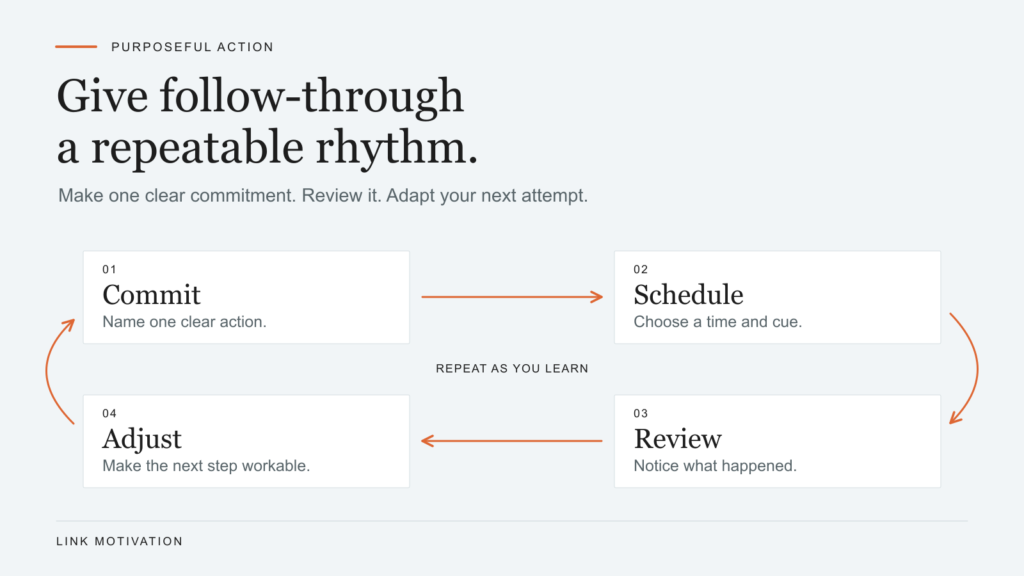
- Review what you learned and select the next step.
The purpose is useful evidence, not a finished career plan in seven days. You can adjust the pace to your circumstances and repeat the exercise with another direction.
Make space to explore your next chapter
Clarity & Direction coaching offers a structured conversation about your priorities, options, and practical next steps. To discuss what you want from your transition, request a free 30-minute Clarity Call. Requests are reviewed before confirmation.
Keep exploring
Continue with Lead Through Change Without Pretending You Have Every Answer, or browse all Link Motivation insights.