
A big decision can look like a comparison between two opportunities while feeling like a disagreement within yourself. One option offers stability. Another offers room to grow. You want to be dependable, but you also want something to change.
When every option has a reasonable argument, more information may help without settling the question. You also need a way to decide what deserves the greatest weight. Taking time to clarify your values gives you a basis for that conversation with yourself.
You do not need a perfect statement of who you are. You need a few priorities you can explain, evidence of what they mean in your life, and a next step that respects your actual circumstances.
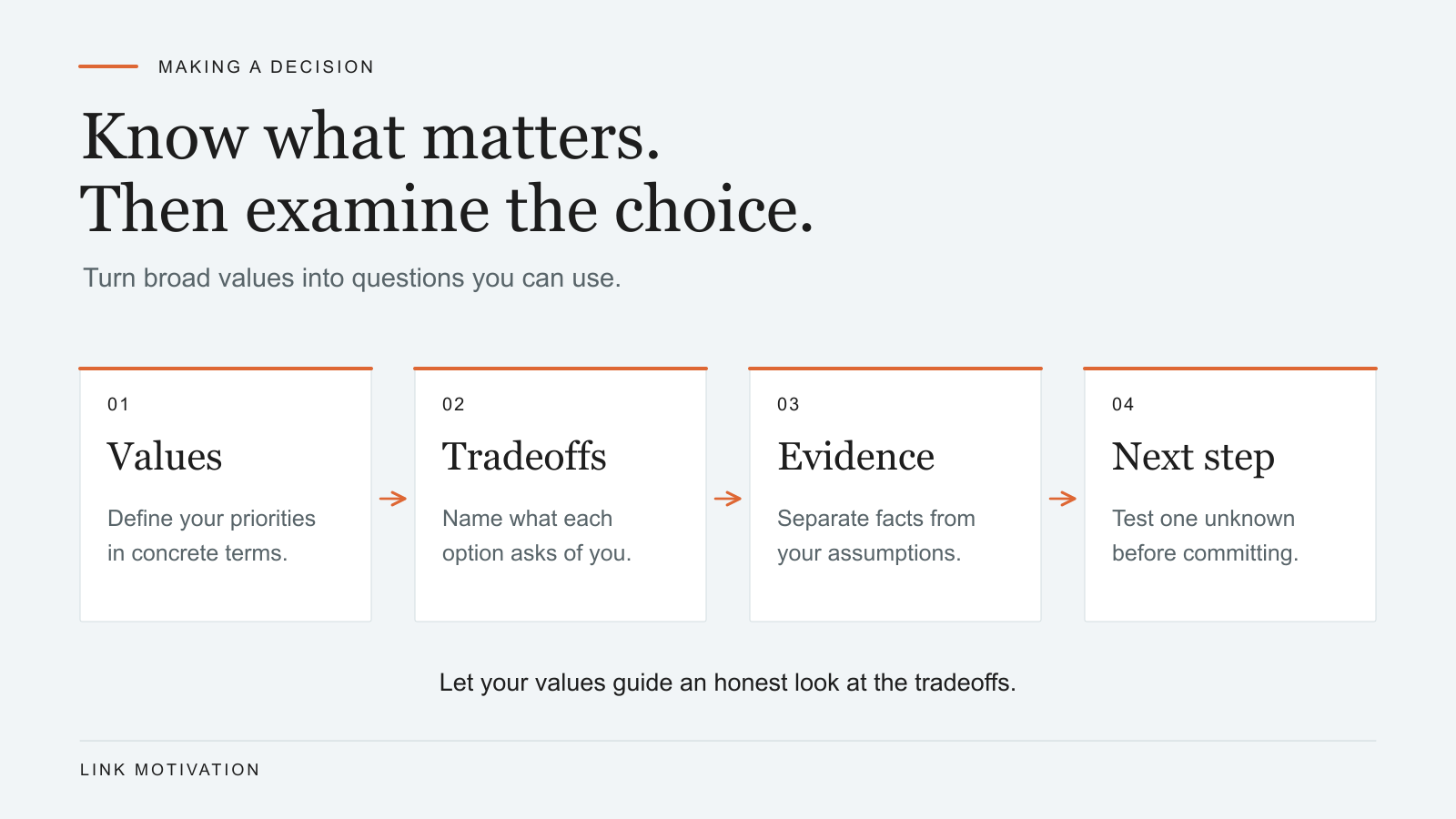
Values describe how you want to live
A goal is an outcome you want to reach. A value describes something you want to practice or protect as you pursue it. “Get promoted” is a goal. “Keep learning,” “act with integrity,” and “be present for my family” might be values that influence how you pursue that promotion.
Values can point in different directions. Learning may invite a stretch assignment; being present may place limits on its travel requirements. Neither priority becomes less sincere because it creates a difficult choice. The useful question is how each option allows you to honor them, and at what cost.
1. Name the decision you are actually making
Write one sentence that describes the choice, the available options, and any real deadline. Keep it narrow enough to investigate.
“What should I do with my life?” leaves you with an enormous task. “Should I apply for the management opening this month or remain in my current role while exploring another path?” gives you something workable.
Then separate the decision from the story surrounding it. “If I stay, I have no ambition” is an interpretation. “The new position includes evening meetings twice a week” is a condition you can evaluate. Include practical constraints such as income needs, caregiving responsibilities, and existing commitments. A choice should account for those realities.
2. Find values in ordinary evidence
Start with three moments from the past few months: one that felt worthwhile, one that frustrated you, and one in which you respected your own response. Describe what happened before assigning a value to it.
- What made the worthwhile moment matter?
- What felt missing or compromised in the frustrating moment?
- What did your response protect in the moment you felt proud of?
Your answers may point toward contribution, independence, connection, reliability, creativity, fairness, or something else. Use words that sound like you. “Have enough room to think carefully” can be more useful than choosing an impressive word you cannot connect to daily life.
Choose three values most relevant to this decision. This is a working shortlist, not a permanent ranking of everything you care about.
3. Give each value a visible meaning
For each value, complete this sentence: “In this decision, honoring this value would look like…” Make the answer observable enough that you could recognize it in a typical week.
For example, growth might mean receiving useful feedback and practicing a new skill. Connection might mean having regular, unhurried time with important people. Independence might mean controlling how you organize your work, rather than working alone.
Next, write one boundary and one flexible preference. You might need to keep a particular evening commitment while being willing to change your morning routine. Naming that difference prevents every preference from becoming a requirement and every requirement from becoming negotiable.
4. Make the tradeoffs explicit
Give each option a short paragraph. Describe which values it supports, which it puts under pressure, and what you would need to give up or adjust. Include the cost of staying where you are; familiar choices also have consequences.
Suppose you are considering a role with more responsibility. It may support learning while reducing schedule flexibility. Before calling that a good or bad fit, investigate the actual expectations. “Leadership opportunities” tells you less than knowing who provides feedback, how decisions are made, and when you are expected to be available.
Ask yourself: “Which compromise could I explain honestly and live with for the next six months?” Then ask: “What would make that compromise unacceptable?” Your answers can reveal conditions worth discussing before you commit.
5. Check your assumptions and choose a next step
Mark each important statement as something you know, something you assume, or something you need to ask. This keeps an attractive possibility from quietly becoming an assumed fact. It also helps you notice when uncertainty, rather than a values conflict, is holding up the decision.
Choose one action that will produce useful evidence. You could ask about the role’s weekly schedule, speak with someone doing similar work, or test a proposed routine. Make the action specific, give it a date, and identify what you want to learn.
Afterward, return to your three values. What became clearer? Which tradeoff changed? What still needs an answer? You may be ready to decide, or you may need another focused step. Either way, you have a reason for moving forward.
Put your priorities into practice
Clarifying your values will not remove every difficult feeling. It can help you recognize what you are choosing to support and what you are willing to accept along the way.
If you would value a structured conversation about your next decision, explore Clarity & Direction coaching at Link Motivation or request a free 30-minute Clarity Call with Dr. Kimble. Appointment requests are subject to approval.
Keep exploring
Continue with Career Transition After Military Service: Translate Your Experience Into a Next Step, or browse all Link Motivation insights.