
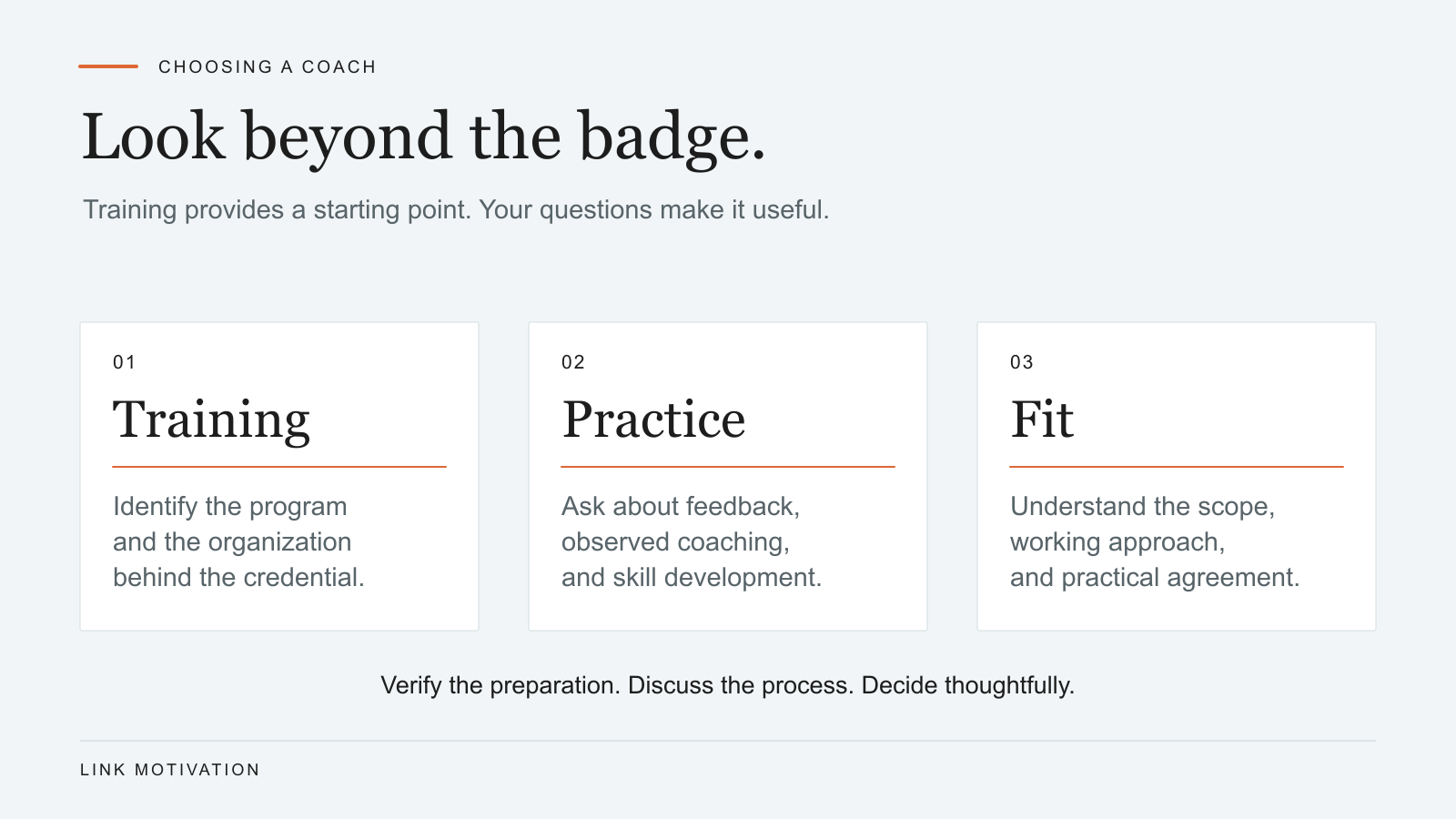
When you are choosing a life coach, a certification can be a useful starting point. It gives you something specific to ask about: who provided the training, what the coach practiced, and how the learning was assessed. The next step is to connect that background with the experience you want as a client.
A title alone cannot answer every question about fit. You still need to understand how a coach works, what the relationship involves, and whether there is room for your priorities. A thoughtful choice considers both the credential and the conversation behind it.
Look for the learning behind the credential
Coach Training Alliance describes its Certified Coach Program as combining mentoring, coaching practice, observation, and feedback. Its published learning process includes opportunities to coach, be coached, and receive a critique. These details make the training more concrete than a badge by itself.
When you review any coach’s background, ask what they had to demonstrate and how their work was evaluated. You do not need to become an expert in every training program. You are looking for an explanation you can understand and an issuing organization you can verify.
Dr. Kimble is a Certified Life Coach through Coach Training Alliance. That is the specific certification described by Link Motivation. Ask for the exact name and issuer of any additional credential rather than assuming that a program’s recognition establishes a separate credential for every graduate.
Consider what the training could mean for your sessions
CTA’s published coaching principles emphasize clarifying what the client wants, encouraging self-discovery, supporting client-generated solutions, and accountability. In practical terms, these principles give you questions to bring to an introductory conversation.
Will there be time to define what you want from a session? How does the coach help you examine options? What happens when you disagree with an interpretation? How will the actions you choose be reviewed? Listen for a working approach you can picture, not only an appealing description of the outcome.
Ask five questions before choosing a coach
1. What training and certification have you completed?
Ask for the full program name and issuing organization. Then read the issuer’s description. Keep education, professional experience, and additional credentials distinct in your notes. A coach’s leadership background may offer useful context, but it answers a different question from how they learned and practiced coaching.
2. How would we decide what to work on?
Bring one topic you are considering and ask how an initial conversation might approach it. You are listening for room to clarify your own goals. An explanation of the process can be useful without requiring the coach to promise a particular result or design an entire engagement before meeting you.
3. What are the boundaries of the working relationship?
Clarify the services offered, session format, fees, scheduling, and cancellation arrangements. Ask what communication between sessions is included and what is outside the agreed scope. Also ask how personal information and notes are handled. Specific answers help you compare options and understand what you would be committing to.
4. How will we review whether the work is useful?
Ask how goals are revisited and how you can raise concerns about the process. A review might consider a decision you have clarified, an action you attempted, or something you learned from an outcome. Choose indicators relevant to your situation, rather than treating a general promise of transformation as a measurement.
5. What happens if the fit or focus changes?
Discuss how to revisit the arrangement if your priorities shift. You may need a different cadence, a narrower focus, or time to consider another kind of support. Understanding how those conversations would happen gives you a more complete picture of the relationship before you start.
Use a simple evidence-and-fit worksheet
After an introductory conversation, take a few minutes to write three short notes for each area below. Record what you learned, what remains unclear, and the next question you would ask.
- Training: Can I identify the certification and the organization behind it?
- Process: Can I describe how we would choose a focus and work through it?
- Participation: Did I have room to think, ask questions, and clarify my perspective?
- Practical fit: Are the scope, time, cost, and communication expectations workable?
- Review: Do I understand how we would discuss progress or concerns?
A blank space is a reason to ask another question. You do not need to turn the worksheet into a numerical ranking. Its purpose is to make your reasoning visible so that an impressive title or a pleasant conversation does not become your only basis for deciding.
Choose a relationship that leaves you responsible for your choices
Certification provides information about a coach’s preparation. You can then assess how that preparation appears in their listening, questions, boundaries, and approach to accountability. The two parts belong together.
You should be able to explain what you hope to work on, understand the proposed arrangement, and decide whether you want to proceed. Give yourself space to consider the fit and ask for clarification. The decision is about a working relationship you can participate in thoughtfully.
Bring your questions to a first conversation
If you are exploring Clarity & Direction coaching, bring both your goals and your questions about the process. Request a free 30-minute Clarity Call with Dr. Kimble to discuss a possible starting point. Appointment requests require approval before confirmation.
Keep exploring
Continue with Clarify Your Values Before Your Next Big Decision, or browse all Link Motivation insights.