
A difficult conversation often starts long before anyone speaks. You replay what happened, imagine the response, and revise your opening line. The longer you rehearse the entire exchange alone, the easier it becomes to arrive with a conclusion before the other person has contributed.
Preparation can help you enter the conversation with a clearer purpose. It gives you a way to identify what happened, explain why it matters, and make room for information you do not yet have.
You cannot prepare another person’s response. You can prepare your own approach and decide what a useful next step would look like.
Start with the purpose, not the perfect wording
Before writing an opening sentence, finish this one: “By the end of this conversation, I hope we understand…” Your answer might concern a missed commitment, a recurring misunderstanding, or different expectations about a shared responsibility.
Keep the purpose within the scope of one conversation. “Make them respect me” depends on an internal change you cannot observe or direct. “Agree on how we will communicate when a deadline is at risk” gives both people something specific to discuss.
For everyday workplace disagreements, the following preparation can make your message easier to understand and your questions more useful.
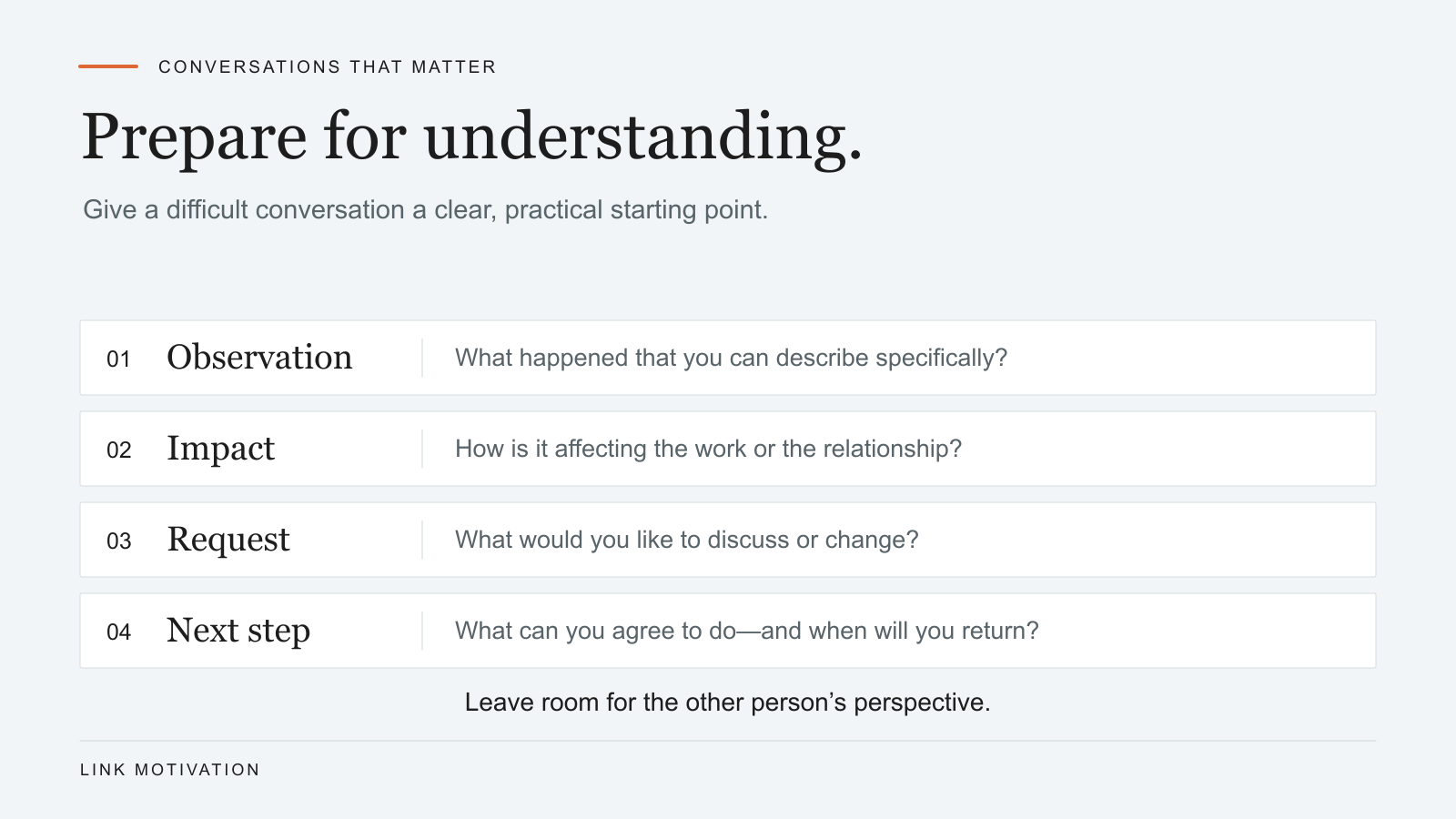
1. Separate observation from interpretation
Write down the event as plainly as you can. Include what you directly saw, heard, or received. Then list the meaning you have attached to it in a separate sentence.
“The draft arrived after our agreed deadline, and I had one hour to review it” describes an event and its practical effect. “You do not care about my time” assigns a motive. You may feel that way, but the conversation will be more grounded if you begin with the event.
Check your notes for words such as “always,” “never,” or “everyone.” Replace them with specific examples you can explain accurately. One relevant example is often more useful than a long list assembled to prove your case.
2. Identify the impact and the request
Explain why the issue deserves attention. Focus on the work, the agreement, or your ability to contribute. You can name your own frustration without making the other person responsible for every feeling attached to the situation.
Then decide what you want to ask for. A useful request describes an action, a circumstance, or a shared agreement. “Communicate better” leaves too much open to interpretation. “Let me know by noon if the draft may be late so we can adjust the review” creates a starting point.
Consider what is flexible. Perhaps the timing can change, while advance notice remains important. Knowing that distinction helps you listen for workable alternatives instead of defending one proposed solution.
3. Choose a workable time and setting
Give the conversation enough time and privacy for the topic. Avoid introducing a sensitive issue as someone is leaving for another commitment or in front of people who do not need to be involved.
A brief invitation can reduce uncertainty: “Could we set aside twenty minutes to discuss the last project handoff? I’d like us to agree on a process for the next one.” Be clear about the subject without presenting the entire argument in the invitation.
If you are speaking remotely, choose a format that allows questions and clarification. Whatever the setting, make sure you can give the person your attention.
4. Prepare an opening that leaves room to respond
Combine the observation, impact, and purpose in a few sentences. Then ask an open question and pause.
For example: “The draft arrived after the deadline we agreed on, which left one hour for review. I want us to have enough review time on the next project. What affected the timing from your side?”
Listen for information that changes your understanding. You may discover different expectations, a dependency you did not know about, or a disagreement that needs to be stated directly. Ask follow-up questions before moving to your preferred solution.
You can acknowledge someone’s perspective without agreeing with every part of it. “I understand that you were waiting on another team” can sit alongside “We still need a way to flag the delay earlier.”
5. Plan for a difficult moment
Think about what you tend to do when a conversation becomes uncomfortable. You might talk faster, soften the request until it disappears, or return to the same point repeatedly. Choose one response you want to practice instead.
- If you rush, pause before your next sentence.
- If the topic widens, return to the specific agreement under discussion.
- If you need time to understand a response, ask a clarifying question.
- If the conversation stops being productive, suggest a pause and a specific time to return.
Preparation does not require predicting every objection. A few simple responses can help you stay connected to your purpose when the exchange takes an unexpected turn.
Close with an agreement you can recognize
Before finishing, summarize what you heard and check whether your understanding is accurate. State any agreed action, who will take it, and when you will revisit the issue. If you have not reached agreement, name what remains unresolved and decide how to continue.
For related leadership habits, read how to make it easier for your team to tell you the truth. If you would like support preparing for a workplace conversation, explore Leadership & Growth coaching at Link Motivation or request a free 30-minute Clarity Call with Dr. Kimble. Appointment requests are subject to approval.
Keep exploring
Continue with Build Accountability When Motivation Fades, or browse all Link Motivation insights.