
When a team faces a reorganization, a new direction, or a shift in responsibilities, people want to know what the change means for their work. You may be expected to explain a decision while important details are still being worked out. The temptation is to sound more certain than you are, or to wait until you can answer every question.
A more useful approach is to give people something dependable now: an honest account of the situation, clear priorities for the immediate work, and a reliable way to receive updates. You can lead a practical response without pretending the whole path is settled.
1. Separate what is known from what is still open
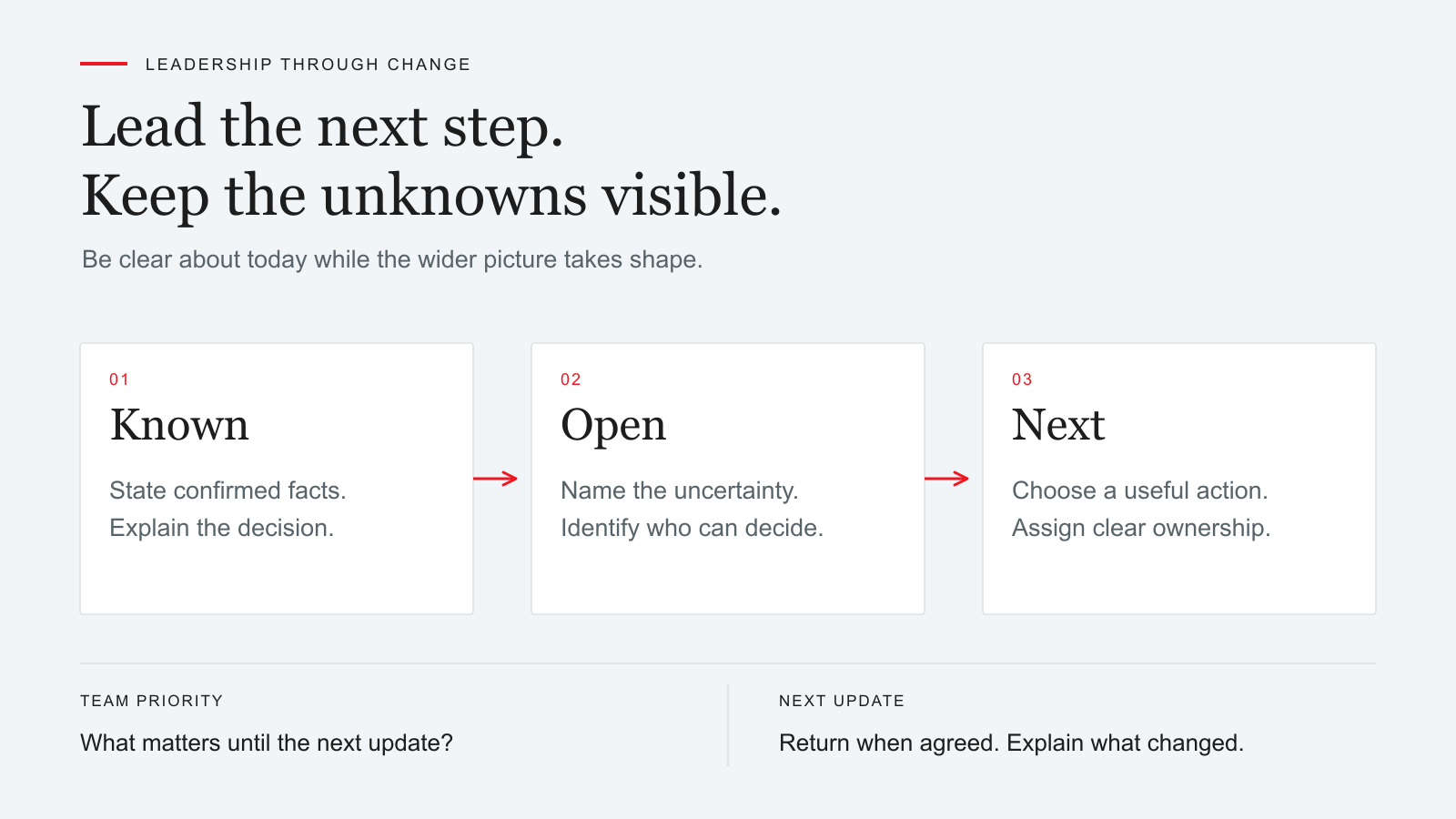
Before your next conversation, divide a page into three sections: confirmed information, open questions, and decisions within your authority. Put each item in only one section. A likely outcome is not yet a confirmed decision. A question that concerns you is not necessarily one you can answer.
This distinction helps you prepare a specific update. Explain what has been decided, what remains under discussion, and who owns the next decision where that information is available. If there are details you cannot share, state that boundary plainly. Avoid filling the space with a reassuring prediction that you cannot support.
Try this opening: “Here is what we know today. Here is what is still being decided. Here is what our team can do while that work continues.” These are suggested words, not a promise that the conversation will be easy.
2. Give the team a workable near-term priority
Translate the change into the next week of work. Which outcome still matters? Which commitments should continue? What can pause until a decision arrives? People need more than an explanation of the future; they need to understand what to do with the tasks already in front of them.
Choose a small number of priorities and say how competing work will be handled. If you add a transition task, name what will receive less attention or discuss what additional capacity is needed. Do not quietly assume that new responsibilities fit on top of a full workload.
For example, a hypothetical service team changing its scheduling process might protect current customer commitments, test one new handoff, and postpone an internal reporting redesign. The point is to make the trade-off visible, not to prescribe those priorities for every team.
3. Be clear about decisions and participation
Some parts of a change may already be fixed. Others may genuinely benefit from team input. Explain the difference before inviting suggestions. Asking people to redesign a decision that cannot change creates a conversation with misleading expectations.
For each open issue, decide whether you are gathering information, seeking a recommendation, or giving the team authority to choose an approach. Identify any constraints, such as an existing deadline or a required standard. Then ask a focused question about the part people can influence.
A useful question might be, “Within the new deadline, which handoff is most likely to create a delay, and what adjustment should we test?” This directs attention to a practical choice while leaving room for concerns about the larger change. Capture those concerns separately when they need a different decision-maker.
4. Create a dependable update rhythm
Agree on when and where updates will appear. The appropriate rhythm depends on the pace of the situation: a short daily check during a fast-moving handover or a weekly update during a longer transition. Choose something you can maintain.
Use the same three headings each time: what changed, what remains open, and what happens next. If there is no new decision, say so and explain what is being checked. An update can be useful even when it does not contain a final answer.
Keep a short decision record that the team can access. Include the decision, its date, the person responsible, and any point at which it should be revisited. When your direction changes, acknowledge the previous instruction and explain the reason for the change instead of leaving people to reconcile two versions.
5. Review the effect, not just the announcement
After a change reaches the work itself, ask what is happening. Are responsibilities understood? Is a handoff being missed? Has a task become harder than expected? Look for specific examples rather than asking only whether everyone is comfortable with the plan.
Choose one adjustment you can make, assign an owner, and set a date to check it. If a problem sits outside your authority, explain how you will raise it and what the team should do in the meantime. For more on responding when people bring difficult information, read how to make it easier for your team to tell you the truth.
A ten-minute preparation exercise
Before your next team update, finish these five sentences:
- What I can confirm today is…
- The most important open question is…
- Our priority until the next update is…
- The team can influence…
- I will return with an update on…
Read your answers aloud. Remove predictions presented as facts and commitments you cannot keep. The result should give people a clear picture of the present and a realistic next step.
Prepare for the leadership conversation ahead
Leadership & Growth coaching offers space to examine a real leadership situation and prepare your response. To discuss the change you are navigating, request a free 30-minute Clarity Call. Requests are reviewed before confirmation.
Keep exploring
Continue with How to Delegate With Clear Expectations and Accountability, or browse all Link Motivation insights.